
Kempower Debuts Dual-Standard Charger Bridging Cars and Heavy Trucks
Authored by forosoyluna.com, 20/09/2026
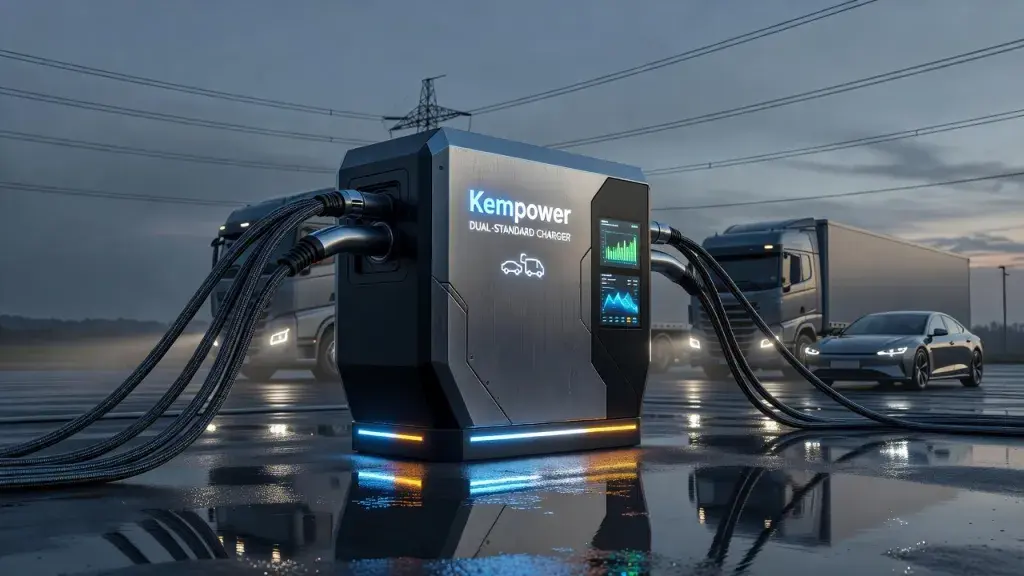
A single charging dispenser that can fuel a passenger sedan and a heavy-duty truck without separate infrastructure is no longer a concept on a slide deck. Kempower has unveiled the Mega Satellite Flex, a charger capable of delivering up to 560 kW through the established CCS standard or up to 1.2 MW through the emerging Megawatt Charging System, marking the company's first dispenser built to handle both. The announcement came this week at ACT Expo, during Kempower's Unplug & Recharge event for customers and partners.
Why One Machine for Two Standards Matters
The electric vehicle charging industry is in an awkward middle stage. CCS remains the dominant plug for cars and light commercial vehicles, while MCS is only now being built out to support electric trucks that require far more power to make long-haul routes practical. Operators have generally faced a binary choice: invest in CCS infrastructure now and risk a costly retrofit later, or wait for MCS to mature and lose out on current revenue from car charging. Site planning has also grown more complex as network operators weigh questions of location, power capacity, and even connectivity infrastructure, much the way businesses evaluate providers offering static IPs when they need consistent, predictable network performance rather than something that might shift or degrade over time. Kempower's approach removes that dilemma by putting both standards into a single unit, letting a site owner serve today's car traffic while preparing for tomorrow's electric trucks without a second construction project. providers offering static IPs
The Technical Case for Flexibility
The specifications point to a genuinely dual-purpose device rather than a compromise. The Mega Satellite Flex handles up to 1,500 amps for MCS charging and 700 amps for CCS, with cable lengths of 5 meters for CCS and 2.7 meters for MCS to accommodate different vehicle geometries. It also supports 800-volt EV architectures, an increasingly common design in newer electric vehicles that allows for faster charging without excessive current. An optional payment terminal makes it viable for public-facing sites, not just fleet depots. Because it works within Kempower's existing distributed charging architecture, operators already running Kempower systems can add the unit without reengineering their power distribution or site layout.
What It Means for Site Economics
Utilization is the metric that determines whether a charging site turns a profit, and idle hardware is the industry's persistent problem. A charger that can only serve one vehicle category sits unused whenever the other type shows up. By serving both car and truck traffic from installation, the Mega Satellite Flex is designed to keep utilization higher from the outset, which shortens the return-on-investment timeline that has made truck charging infrastructure a difficult sell for investors. That matters most along corridors where car and freight traffic overlap, and where land and grid connections are expensive enough that building two separate charging areas is not realistic.
A Signal for the Road Ahead
The Mega Satellite Flex is expected to reach North America and Europe in July 2026, giving the market over a year to plan around it. Its real significance may be less about the hardware itself and more about what it signals: charging infrastructure is moving toward flexible, standard-agnostic systems rather than purpose-built silos. As MCS adoption grows alongside the continued dominance of CCS, hybrid chargers like this one could become the default expectation for any new site rather than a specialized offering.